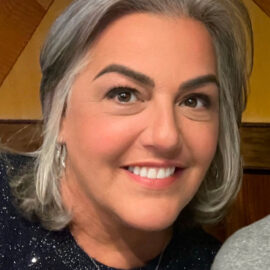
How my story begins: I started having constant bleeding — and a lot of it. I went to my local OB-GYN, but for over a year my concerns were dismissed. I was told it was all in my head. Deep down, I knew something wasn't right, but I trusted them. They had delivered my children, so I believed they knew what they were doing.
They suggested birth control to slow the bleeding, assuming it could be perimenopause. When that didn't help, they increased the dosage to two packs a day. Looking back, I should have known that wasn't right.
A few months later, I developed a blood clot in my leg from the pills — and the bleeding came back worse than ever. That's when I switched doctors. The new OB-GYN immediately said, "This is not normal. Let's start with a Pap and go from there."
The Pap came back with multiple abnormal results, and he told me I needed to go to Penn Medicine in Philadelphia as soon as possible.
Life before my diagnosis: Before cancer, life was full and happy. I had two kids, a husband, a good job, and a strong circle of friends. I was always healthy and took good care of myself. Life felt stable, busy, and genuinely great — and I moved through it without ever imagining how drastically things could change.
How I felt after diagnosis: When Penn Medicine told me I had Stage 1B1 cervical cancer and needed surgery as soon as possible, everything stopped. I remember feeling shocked, numb, and terrified all at once. I had walked in looking for answers and walked out with my life suddenly divided into before and after.
I kept thinking about my kids, my husband, and how quickly everything had changed. Just weeks earlier, I had been told nothing was wrong — now I was being told this was cancer and it couldn't wait. The urgency was overwhelming, but at the same time, I felt a strange sense of relief. I finally had an answer, and someone was taking me seriously.
Fear and gratitude existed side by side. I was scared of the surgery, scared of the unknown, but thankful that I was finally in the right hands and moving toward treatment instead of being dismissed.
Telling my family and friends: Telling my family and friends was one of the hardest parts. I had to say the word cancer out loud before I had fully processed it myself. Every conversation felt heavy, and I could see the fear in their faces, even when they tried to stay strong for me.
I worried about my kids the most — how much to tell them and how to protect them while facing my own fear. My husband became my anchor, steady when everything else felt out of control.
At the same time, I was surrounded by love. Friends showed up in ways I didn't expect, reminding me that I wasn't going to face this alone. Even in one of the scariest moments of my life, I felt held by the people who mattered most.
My treatment: My treatment was an open radical hysterectomy with several biopsies. Everything came back clear, and I was told I didn't need chemotherapy or radiation. I truly believed it was behind me.
I stayed diligent with all of my follow-up appointments, trusting that I was moving forward. It was during one of those routine follow-ups that they found a recurrence in my lung. I couldn't believe it had come back. I had done everything right, followed every appointment, and truly believed cancer was behind me.
Now I was facing a lung resection, combination chemotherapy, and years of maintenance treatment — best case. I was completely shocked. It felt unreal that this was my life again.
Then one day, something shifted. I woke up and decided I wanted to live — fully and unapologetically. From that moment on, I knew every doctor on my team needed to be on my side, fighting with me. If they weren't, they were gone.
How I felt after treatment: After treatment, it took a couple of years for me to truly process everything. I kept asking myself, "How did I get here? What happened?" It was hard to make sense of how quickly life had changed.
As the years went by — through maintenance therapy and 17 PET scans — I slowly began to grasp it. The shock faded, and understanding took its place. I wasn't just surviving anymore; I was learning how to live with what had happened and how to move forward without letting fear define me.
What was most difficult for me: The shock was the worst part. Treatment was something I could face, but the sudden shift from "fine" to "life-threatening" was harder to recover from.
What I did to help myself: What helped me most was deciding to take control of what I could. I became my own advocate, asked questions, and made sure I understood every step of my care. I surrounded myself with doctors who listened, supported me, and believed in fighting alongside me.
I focused on my mindset, choosing to show up every day with determination — even on the hard days. I leaned on my family and friends, accepted help when I needed it, and gave myself grace when I didn't have all the answers.
Most of all, I made a conscious decision to live. I didn't let fear dictate my future. I took things one day at a time, trusting my strength and the team I built around me.
My life after cancer: Life after cancer took a long time to rebuild. It didn't come back on its own — I worked very hard to create the life I have today.
Where I am today: Now, as I begin year six of NED from my lung recurrence and eight and a half years from my diagnosis, I'm starting to put my life back together. I took a less stressful job and work from home, spending my days with my dogs by my side.
My kids are doing well — one is graduating from college this year, and the other from high school. I've slowed down my pace of living and learned to appreciate what truly matters. I'm deeply grateful for each day and the life I've been given.
How I will try to help others: I share my story often to educate others and to show that cancer can happen to anyone. I want people to listen to their bodies, trust their instincts, and advocate for themselves when something doesn't feel right.