Happy 20th Birthday, HPV Vaccine: A Love Letter on International HPV Awareness Day 2026

By Sara Lyle-Ingersoll, Cervivor Communications Director
Happy 20th birthday, HPV vaccine!

Two decades is a big deal. Cervivor marked the same milestone last year, so we know a bit about what 20 years of impact feels like.

We still remember the excitement in 2006 when the first HPV vaccine was approved by the U.S. Food and Drug Administration (FDA). The news made the cover of Time magazine and the front page of The New York Times. But it wasn’t just another medical headline — it was a major scientific breakthrough. The idea that we could prevent cervical cancer before it ever started felt revolutionary. The hope was palpable.

Which makes today, International HPV Awareness Day — part of the International Papillomavirus Society‘s (IPVS) annual campaign to promote HPV prevention, screening, and care — a fitting moment to say happy birthday, thank you, and keep up the good work. Consider this our love letter to you, HPV vaccine. 

Why We Love You

Let’s start with the obvious: You prevent cancer.

Not symptoms. Not severity. Cancer. 

HPV is incredibly common — about 80% of people will be infected at some point in their lives. Most infections clear on their own, but some persist and can lead to cancer. Globally, HPV causes nearly all cervical cancers and contributes to cancers of the anus, oropharynx (throat), vulva, vagina, and penis. Together, HPV-related cancers account for more than 720,000 new cancer cases and roughly 350,000 deaths worldwide each year. 

When you were first approved in 2006, you protected against four HPV types, including types 16 and 18, which cause the majority of cervical cancers. Today’s version protects against nine HPV types: seven responsible for about 90% of cervical cancers, plus two that cause most genital warts. That’s pretty badass. Pardon our language.

Because prevention works best before infection occurs, vaccination is recommended between age 11 and 12, and can be given as early as 9. In this video for HPV Day 2026, IPVS envisions a world free from the cancer-causing virus — made possible in large part by you. 

Your Track Record Speaks for Itself

More than half a billion doses of the HPV vaccine have been given out worldwide, and decades of safety monitoring across multiple countries continue to confirm that you are safe. 

Any side effects are typically mild and temporary, and serious reactions are rare. The Centers for Disease Control and Prevention (CDC), the World Health Organization (WHO), and numerous independent reviews consistently affirm your safety.

And are you effective? Heck, yes! The data is just as strong. 

Countries with high vaccination coverage — think Australia, Rwanda, Sweden — have documented dramatic declines in HPV infections, genital warts, and high-grade cervical precancers among young people. 

This is no longer about projections or promises. The receipts are in. Here are just a few: 

  • A landmark 2020 study published in The New England Journal of Medicine found that Swedish girls vaccinated before age 17 had an 88% lower risk of cervical cancer compared to unvaccinated peers. 
  • In the U.K., research published in The Lancet in 2021 showed nearly a 90% reduction in cervical cancer among women vaccinated between 12 and 13.
  • In the U.S., a 2025 CDC analysis of 2008–2022 data found that cervical precancers among women 20 to 24 — the first generation routinely vaccinated — declined by roughly 80%.

That’s measurable progress and lives saved. Wow, just wow. 
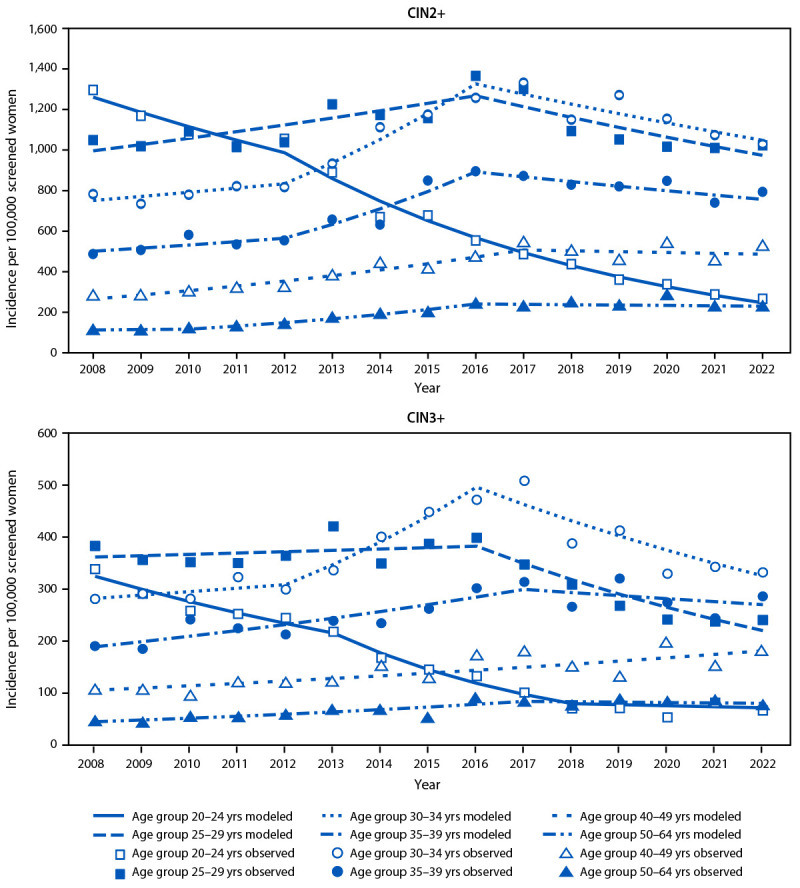
U.S. rates of moderate to severe cervical precancers (CIN2+ and CIN3+) declined sharply from 2008 to 2022 among women 20 to 24 — the first generation routinely vaccinated against HPV. 

We Know It Hasn’t Always Been Easy

From the beginning, you carried more than a syringe and a schedule. You carried stigma — something anyone affected by a below-the-belt cancer understands all too well.

Because HPV is transmitted through intimate contact, conversations about the vaccine have often been wrapped up in discomfort, misinformation, and politics. Some struggle discussing a sexually transmitted virus with preteens. Others falsely claim you’re a “permission slip” for promiscuity. 

At the recent 2026 Cervical Cancer Summit — while unpacking your complicated history — Chief Medical Officer of the Association of Immunization Managers Michelle Fiscus, MD, FAAP, shared an old cartoon poking fun at the promiscuity myth. It showed a young girl receiving the HPV vaccine and saying, “I am so turned on right now.” The joke landed because the premise was so absurd.

A vaccine does not change a child’s values or lifestyle choices. It reduces their risk of cancer. Full stop.
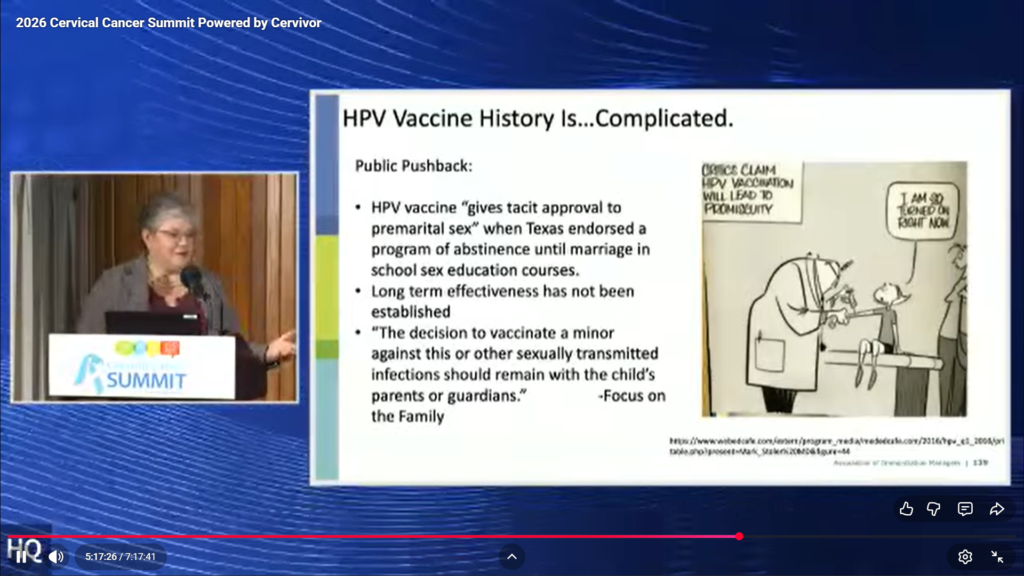
At the 2026 Summit, Association of Immunization Managers CMO Michelle Fiscus emphasized that “misinformation remains one of our biggest barriers,” calling the promiscuity myth “farcical.”

In Case You Need to Hear This

Progress hasn’t been perfect — but that’s not on you. 

Vaccination rates vary widely by region and community. In the U.S., HPV vaccination coverage among adolescents continues to improve, but it still trails other routine adolescent vaccines like Tdap and meningococcal, according to the CDC. Research shows that a strong provider recommendation is one of the biggest factors in increasing HPV vaccination.

Globally, cervical cancer disproportionately affects women in low- and middle-income countries, where access to both vaccination and screening can be limited. The WHO’s strategy to eliminate the disease as a public health problem calls for 90% of girls to be fully vaccinated against HPV by age 15.

It’s simple math: The more people who receive you, the more lives will be saved from HPV-related cancers — which is why we’re your hype girl today and every day. 
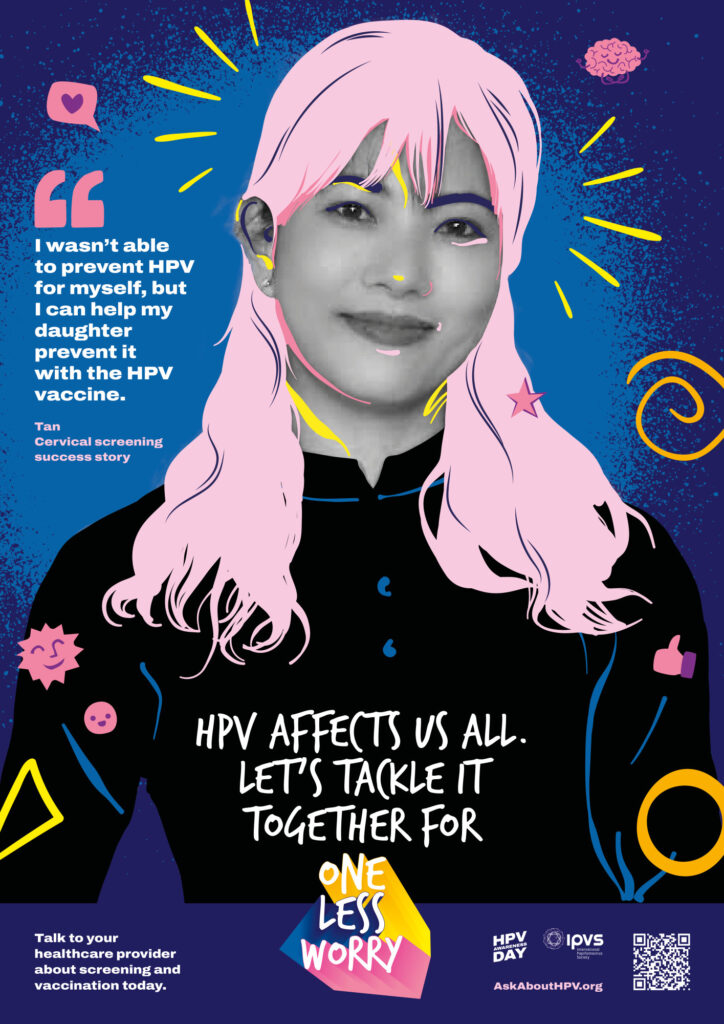
For HPV Day, the IPVS shares a message of unity. 

Keep On Keeping On!

HPV vaccine, you have given us a tool that previous generations couldn’t even dream of. 

Twenty years ago, approving the first HPV vaccine was an act of scientific courage and public health ambition. Today, the challenge is simpler — and harder. We have to use it.

Reflecting on the momentum of the first National HPV Conference last April, Cervivor Founder and Chief Visionary Tamika Felder said, “Knowledge is power, but this is just the start. Preventable cancers like cervical cancer are on the rise because of complacency, stigma, and misinformation. The time to prevent suffering — and save lives from cervical and other HPV-related cancers — is now.”

Your moment is now. 

Happy 20th birthday to a vaccine that prevents cancer.

Here’s to a future when a cervical cancer diagnosis or, worse, a death is ancient history. 

P.S. Congratulations to the St. Jude HPV Cancer Prevention Program on five years of saving lives by increasing HPV vaccination rates! We couldn’t be prouder to call you a partner.

About the Author

SARA LYLE-INGERSOLL is a content and communications expert dedicated to transforming lived experiences into impactful stories. Her award-winning magazine feature about a close friend who passed from cervical cancer in their twenties led her to connect with Cervivor’s founder, Tamika Felder, and solidified her commitment to cervical cancer awareness and prevention. Now, as Cervivor’s Communications Director, Sara brings this mission full circle.

From Awareness to Action: Empowering Voices to End HPV-Related Cancers

Every year, over 600,000 people worldwide are diagnosed with HPV-related cancers, including cervical, anal, oropharyngeal, penile, vulvar, and vaginal cancers. In the United States alone, more than 14,000 women are diagnosed with cervical cancer annually. These statistics highlight the urgent need for awareness, education, and collective action—especially on HPV Awareness Day (March 4). The good news? Many of these cases and deaths are preventable.

The Facts About HPV

Human papillomavirus (HPV) is extremely common, with 80% of people contracting it at some point in their lives. Despite its prevalence, many people mistakenly believe that HPV only affects women. However, HPV can affect anyone, regardless of gender. One of the challenges with HPV is that it often has no visible symptoms, making it difficult to know if you have it.

While cervical cancer accounts for most HPV-related cancer diagnoses, cases of head and neck and anal cancers in both men and women are increasing. In fact, HPV is responsible for 60,000 cancer diagnoses in men each year. 

Although there is no approved screening test for other HPV-related cancers, for individuals with a cervix, cervical cancer screening can detect abnormal cells in the cervix that could develop into cervical cancer, while an HPV test indicates that the virus is present in the cervix. If you notice genital warts or have concerns about HPV, it’s essential to speak with your healthcare provider to detect and treat HPV early.

Expert Insights with Dr. Shobha S. Krishnan

Dr. Shobha S Krishnan is a renowned board-certified family physician and gynecologist with over 30 years of experience in primary care and women’s health. As the Founder and President of the Global Initiative Against HPV and Cervical Cancer (GIAHC), she has dedicated her career to combating cervical cancer and HPV-related diseases globally. Her work has taken her to various parts of the world, including rural India, where she has implemented innovative screening and treatment methods, such as visual inspection with acetic acid (VIA) and cryotherapy.

“Cervical cancer is something that we can almost completely eliminate by vaccination and screening. However, we should not even have one death, because we have the tools to prevent it.”

– Dr. Shobha S Krishnan, Future Science OA

Through GIAHC, Dr. Krishnan aims to educate providers, parents, and the public about the importance of HPV vaccination, screening, and early treatment. Despite the challenges faced in both developed and developing countries, Dr. Krishnan remains committed to making the HPV vaccine affordable, accessible, and acceptable to all. Her organization has partnered with various groups, including the American Medical Women’s Association, to raise awareness and promote education about HPV and cervical cancer. Her book, “The HPV Vaccine Controversy,” is a valuable resource for anyone seeking to understand the disease and the importance of vaccination.

Meet Morgan Newman: A Young Adult’s Journey with Cervical Cancer

At just 24 years old, Morgan Newman received the devastating news that she had stage III cervical cancer. Despite undergoing intense treatments, including chemotherapy, radiation, and a metastatic recurrence to her lungs. “I’ll admit, when I was a teenager, I was very hesitant to get the HPV vaccine. My mom begged me to get it, but I told her no because I was skeptical, and I told her it would never happen to me.”

Soon after Morgan entered the survivorship phase, she found her voice through the Cervivor community by attending a patient advocacy training. Now, 10 years later, she’s on a mission to raise awareness and empower others. Morgan proudly serves as Cervivor’s Community Engagement Liaison. “I’m lucky because I went in for a routine screening, and that’s how my cancer was detected. I’m lucky because my body responded to two journeys with cervical cancer.”

HPV-Related Cancer Survivors Share Their Stories

Quinn Billie Jo was diagnosed with stage III anal cancer, which severely impacted her quality of life. The tumor destroyed her sphincter muscle, causing severe issues like incontinence, and she is now scheduled for surgery, which will result in two colostomy bags, one for urine and one for fecal matter. Despite their resilience, Quinn faces the added burden of stigma surrounding anal cancer, often receiving uncomfortable reactions when sharing their diagnosis. Quinn would like to change that narrative.

Patrick, a penile cancer survivor, is advocating for increased awareness and conversation about human papillomavirus (HPV) and its link to male cancers. After being diagnosed with penile cancer in 2020, Patrick underwent life-altering surgery and treatment. He is now urging young people to get vaccinated against HPV and encouraging older men to speak openly about male cancers, emphasizing that conversations about penile cancer should be as normalized as those about breast cancer.

Ada, a 62-year-old single mother of two, was diagnosed with HPV-positive squamous cell carcinoma after discovering a lump on her neck, which she initially thought was a reaction to a bee sting. Following a series of medical appointments, biopsies, and surgeries, Ada underwent 33 radiation sessions and six rounds of chemotherapy. She credits the bee sting with saving her life, as it led her to discover the cancer. With the support of her loved ones, Ada successfully completed her treatment and rang the bell, symbolizing her triumph over cancer.

Teresa, a 40-year-old Black woman, was diagnosed with vulvar cancer after visiting her doctor about a persistent bump on her vulva. Despite her initial calm demeanor, Teresa’s world was turned upside down when her doctor revealed that the cancer was more aggressive than anticipated. After undergoing two surgeries, including a node dissection, Teresa was relieved to learn that the cancer had not spread to her lymph nodes. Now cancer-free, Teresa advocates for HPV vaccination, particularly among young Black women, who she believes are more vulnerable to the virus. She emphasizes the importance of early detection and encourages open conversations about vulvar cancer to combat shame and stigma.

A Call to Action: Eliminating HPV-Related Cancers

So, what can you do to help eliminate HPV-related cancers? The answer is simple: Every action counts, every voice matters, and every choice can make a difference. By taking control of our own health, sharing our stories, and supporting others, we can create a ripple effect that spreads far and wide. Here are some ways you can join the movement:

  1. Get Informed: Learn about HPV, its risks, and the importance of vaccination and screening. Share this knowledge with others to help spread awareness.
  2. Get vaccinated: The HPV vaccine is available for both males and females and can protect against certain types of HPV that can cause cancer.
  3. Get screened: Regular cervical cancer screening can help detect abnormal cell changes early, when they’re easier to treat.
  4. Share your story: If you or someone you know has been affected by HPV-related cancer, share your story to help raise awareness and support others.

The statistics are staggering, the stories are heart-wrenching, but the message is clear: We have the power to eliminate HPV-related cancers. By sharing our stories, educating ourselves and others, getting vaccinated, and getting screened, we can create a world where no one has to suffer from these preventable diseases.

“Our stories are powerful, but they’re so much more impactful as a collective voice.” – Morgan Newman

Let’s continue to break the silence, let’s shatter the stigma, and let’s unite in our quest for an HPV cancer-free future. Join the movement, share your voice, and together, we can make a difference.