Honoring Culture & Making an Impact

Alexander Hamilton.
General Colin Powell.
Shirley Chisolm.
And Kadiana Vegee.

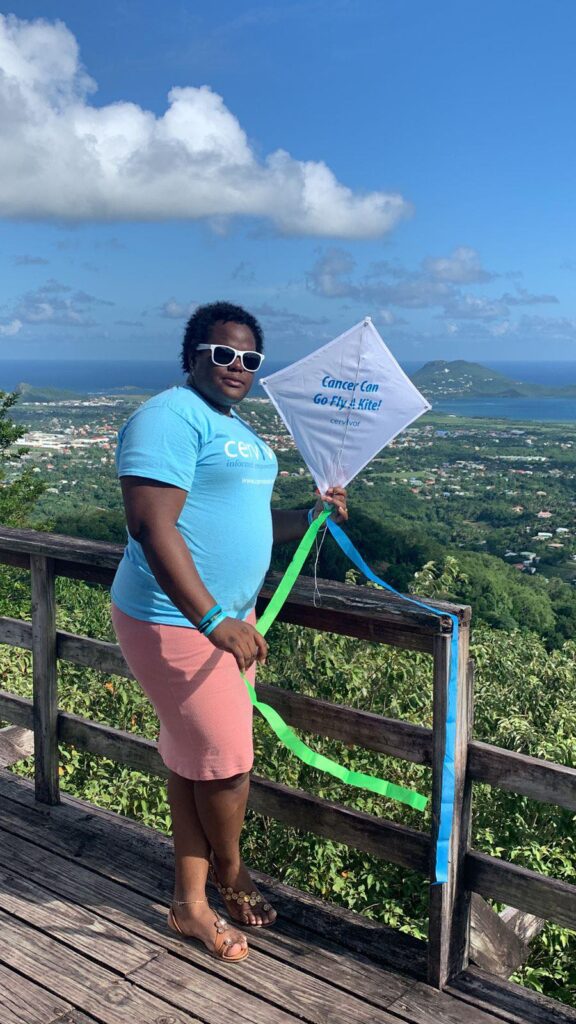
These Caribbean-Americans are worthy of a shout out, and Cervivor wants to shout from the rooftops Kadiana’s name because she is the epitome of beauty and pride. As we celebrate Caribbean-American Heritage Month, we want to share Kadiana’s survivor story which reminds us of true beauty.

Having lost her mother to ovarian cancer, and her father to prostate cancer, Kadiana and her sisters took genetic tests to learn where their own health stood. While her sisters were in the clear, Kadiana’s tests revealed the BRCA 1 gene mutation. She quickly chose to have preventative surgeries.

“I had a double mastectomy without reconstruction, and I also had to have my ovaries and my fallopian tubes removed,” explained Kadiana. “ … The decision that I made was not just for myself and to stay alive, but it was also for my kids.”

The most frequent cancers in the Caribbean are prostate, breast, lung and bronchial, colorectal, and cervical cancers, according to BMC Cancer journal. Further, the five most frequent sites for cancer deaths include lung and bronchial cancers, prostate, colorectal, breast and stomach.

To be specific, Black-Caribbean women have a high prevalence of late-stage breast and cervical cancer diagnosis due to a low prevalence of screenings, according to dignity, shame, stigma, or ignorance in avoidance of breast and cervical cancer screenings among women of Caribbean Descent, published by the Open Journal of Social Sciences. After conducting focus groups, researchers concluded that a lack of trust in the health system, stigma, and shame contributed to avoidance of cancer screening – all similar to what we see and experience for ourselves.

While Kadiana acknowledges cancer will “always be a part of my life, from the long lasting side effects to the constant fear of reoccurrence,” her fervor to thrive, her beauty and her pride in taking back her life can be seen, felt, and heard. We are elated to know that Kadiana is a Cervivor advocate willing to share her story, boast her war scars, and champion the need for rights, resources and self advocacy.

“It felt like a blessing because I knew and I had the option,” said Kadiana about making her decision. “I stand unashamed … It’s not how I look on the outside. It’s how I look on the inside, and I really do feel beautiful.”

Clinical Trial Awareness Month: Cervical Cancer Needs YOU!

That first season of a TV, Netflix, or cable series is a total experiment. Producers wonder how the characters will resonate with the target audience. Advertisers are hopeful that their two-minute commercials and ads are crafted well enough to bring in sales. And actors cross their fingers that fans love each episode more and more, and demand a second season. The result: a cult following of a show that lasts for years, providing viewers the comfort of entertainment and solace.

While it may be a stretch, we can think about clinical trials in the same way. This method of medical research, is in fact, a pilot program for scientists to experiment, test, and prove what works, and what can result in medical breakthroughs – again, for the comfort and solace of those impacted by health challenges like cervical cancer.

You may have heard us at Cervivor championing the dire importance of clinical trials. We continue to stress the importance as this is the only way we can pave a way toward slowing down the loss of members in our community, thriving without having to lose parts of our bodies, and ultimately eliminating cervical cancer.

We said it before:

  • We need clinical trials to drive progress.
  • We need trials to determine the safety and effectiveness of every type of treatment.
  • And in order to determine that safety and effectiveness, we need volunteers.

We choose not to subscribe to the stigma around being a “guinea pig” or a “test dummy.” Without clinical trials, treatment, diagnosis, and prevention efforts are slowed down. The effectiveness of new medication, treatment, and therapy can only be proven through trial – and yes, error. Take a look at the thousands of trials around the globe currently recruiting patients, in addition to those that are active, completed, and terminated with results. Thanks to people including several of our Cervivor community members like Teolita, Erica, Jenn, and Linda much more work is being done daily to make sure our community – and the generation after us, and after them – can thrive.

“I decided that if this clinical trial was good enough for Jimmy Carter, it was good enough for me!” – Teolita Rickenbacker

It’s important to note that Cervivor advocates for cultural competence throughout our medical journey, including in the clinical trials process – and we should all be looking out for this. This means, making sure that the medical community understands, and is intentional about how they communicate with a diverse audience of women, whether Black, Brown, young, mature, and those who speak a language not native to their medical team. It is super important that the medical community, including those coordinating trials, speak different languages, and understand the experience of those who are part of a focus group. This important aspect aids in building and maintaining trust with those participating, which, in turn, helps us trust in both the process and the expertise of trial organizers.

This process takes a lot of teamwork: scientists work on hypotheses, patients report on progress and challenges, and doctors monitor outcomes. The result: an increase in clarity, more answers, more awareness, more options, and longer lives. Have a discussion on clinical trials with your care team and support system. Learn more with these recommended resources:
https://www.webmd.com/cancer/cervical-cancer/cervical-cancer-clinical-trials
https://www.clinicaltrials.gov/ct2/home

If you have experience with a clinical trial and want to share it with us, contact us at [email protected].