The Cervivor Podcast: Season 1 Recap

In anticipation of the Season 2 release, we’re taking a look back on Season 1 of the Cervivor Podcast hosted by our very own Founder and Chief Visionary, Tamika Felder. It was a season where we laughed, cried, and learned from guests during Cervivor School 2017. We give honor and observance to those featured in these podcasts that are no longer with us. To be able to hear their voices, laughter and transparency is a special treat for us. We hope you think so, too.

If you haven’t listened to Season 1 yet, take a moment and do so now – currently available on Anchor.fm, Apple Podcasts, Google Podcasts, Pocket Casts, Radio Public, and Spotify.

Recap by Episode:

  1. Cervivor’s “Most Enthusiastic” awardee, shares all the things we wanted to know but didn’t want to ask in “Dry Panties, Depends, and Urine. What Does This Have to Do with Cervical Cancer?” Turn the volume all the way up and be proud as you listen to Holly Lawson talk about obstacles during diagnosis.
  2. “Everybody’s voice makes a difference,” says Erica Frazier Stum whose school-aged son knows his mother may be gone sooner than she should be. This podcast episode is a special treat hearing Erica’s voice posthumously who passed away in 2019.
  3. “Education 101: What is Lymphedema?” Heather Banks drops a few jewels around compression undergarments, drainage, swelling, and giving yourself grace when you just … can’t. 
  4. Balancing school, work, her grandmother’s dementia, and an unexpected stage 4 cervical cancer diagnosis, Teolita Rickenbacker says she found her calling amidst an overwhelming period. “It’s nothing wrong with having cervical cancer; it’s nothing wrong with having any kind of cancer. It’s just how you define it.” Listen to “The Will to Live: How Faith Got Her Through a Cancer Diagnosis.”
  5. In “Acceptance of Death: How She is Making Her Story Matter,” Lisa Moore shared her story of diagnosis, kidney failure, and coming to grips that once she passed, her 30-year-old husband would likely start a family with someone else. “I have accepted death. I’m done being stuck, I’m done being treated. I’m ready to just live my life … it’s a different kind of hope.”
  6. The aftermath of a car accident reveals Sierra Thetford has cancer, but despite a six-month prognosis to live, she sought solace in sharing her story and becoming a gym rat. Listen to “Wrecking into Cancer: How the Gym Became Her Refuge.”
  7. Lynn Tromp talks about cervivorship globally and being open to new experiences, “I trusted my medical doctor. He spoke to me with confidence. Even though it was a trial, he spoke to me with confidence,” said Lynn who lives in South Africa. Listen to “Cancer in another country: A Tell-all From South African.”
  8. In “Toxicity in Relationships: Coping with Cancer,” Dr. Ramani Durvasula talks with Tamika Felder about feminism, narcissistic relationships, and convoluted thoughts that we can experience during diagnosis and treatment. 
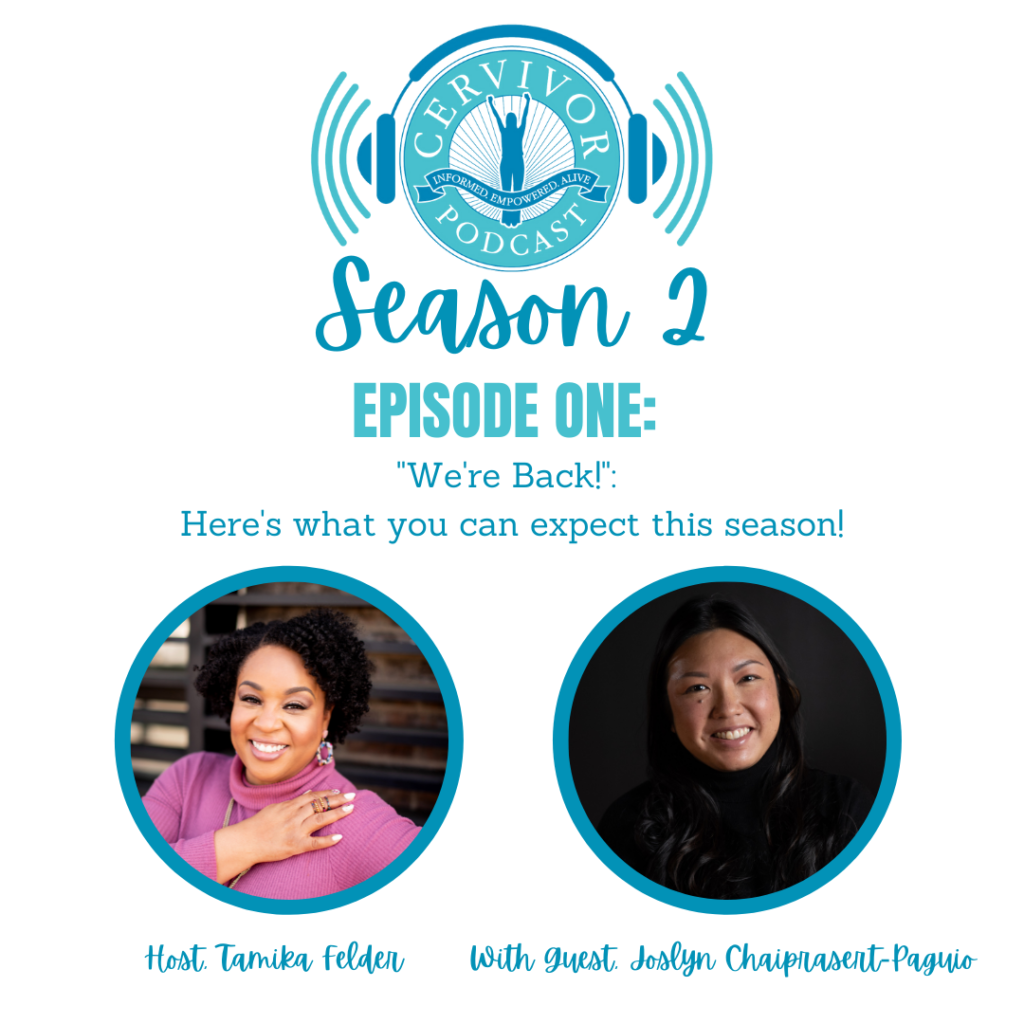
Season 2 of the Cervivor Podcast is moving past the archives. Join us on Friday, May 13, 2022 for the Season 2 Episode 1 release!

We’ll be welcoming our first guest, Joslyn Chaiprasert-Paguio. Joslyn was diagnosed with the Human Papillomavirus (HPV) at the age of 18 and with cervical cancer at the age of 24. She shares her story to encourage women and future generations, like her daughter, to advocate for themselves and make their health a priority. You’ll also hear what else you can expect on this Season of the Cervivor Podcast.

For more Cervivor-related content, check out our award-winning YouTube channel, CervivorTV. Follow Cervivor on all social media platforms and sign up for our newsletter. If you would like to be interviewed for upcoming Cervivor Podcast episodes or to request content or speakers for future episodes, fill out this form or contact us at [email protected].
When the Psychotherapist Meets Cancer

I always thought that I’ve done very well in building up resilience, taking care of my physical and mental health, since that is basically what I do for a living. I am a Psychotherapist and am specialized in Cognitive Behavioral Therapy (CBT). I love the CBT approach in working with clients since it is a here-and-now approach, is time-limited, and is structured. I offer individualized treatment plans for each client that outline clear behavioral goals, as well as take an active role in coaching my clients by directing their therapy and assigning homework.

After undergoing a biopsy, my OB/GYN told me on my daughter’s 2nd birthday, “Unfortunately, it’s cancer”. I just sat there, repeatedly saying, “No, that can’t be true!”. I completely went into freeze response. It was like an out-of-body experience, while I was standing on the Edge of the Abyss, all around me was complete darkness. As I was shaking and crying, all I could continuously say was, “No, that can’t be true!”.

(The definition of Fight, Flight, Freeze or Fawn is the body’s natural physiological reaction to stressful events. It is activated by the perception of threat, quickly igniting the sympathetic nervous system and releasing hormones to reach the underlying goal of springing into fight, flight, freeze or fawn to decrease, end, or evade danger and to return to a state of calm and control.)

My OB/GYN’s office scheduled my first CT scan for three hours later and as my husband, who was thankfully with me at the appointment, brought me outside the office, I started throwing up while I talked to my sister on the phone telling her, “I have cervical cancer”.

At this point, I knew nothing about “my cancer”. Had it spread? Am I going to die? What stage am I? Will I see my girls graduate high school? Is it treatable? What is the chance that my cancer can be cured? What other tests and procedures do I need? How can I deal with that? I’m not the type of person that will be able to handle something like this.

The day after my diagnosis, there I was, sitting with all those thoughts, feelings, and emotions, not knowing what to do. I knew nothing anymore; I wasn’t even able to think. On this beautiful summer day, everything seemed to disappear into this deep fog surrounding me.

I, the psychotherapist, who always comes up with great treatment plans for all kinds of mental health problems my clients are dealing with, but who is now unable to even stop my own thoughts and worries. Wow, great job. I was disappointed in myself. I was disappointed in what my body had done to me by developing this cancer. And on top of that, I wasn’t even able to drag myself into a more positive state of mind. Hell, I could not even think one, clear thought.

So, when I wanted to cry, I cried. When I wanted to scream, I screamed. When I wanted to sleep, I slept.  When I wanted to talk, I talked. And I went on walks, a lot of quiet, long walks. At one point, I went on Google and gathered information about cervical cancer. I reminded myself about one of the things I tell my clients, “Information is on the other side of fear”. 

Then I realized that what is happening is grief. I’m grieving my cervical cancer diagnosis. I’m right in the middle of it and my psyche is doing what it’s supposed to do all on its own. 

We usually reserve the word, grief, for loss, secondary to death. Well, that’s just one form of grief. Grief is an adjustment to loss. When we get our cancer diagnosis, that is loss. Loss of potential quality of life, loss of certain physical functionality. It may even be the loss of time. At some point, everyone WILL go into grief. However, not everyone will go through the stages in a prescribed order, there is no linear and predictable pattern, and we often switch back and forth between the stages.

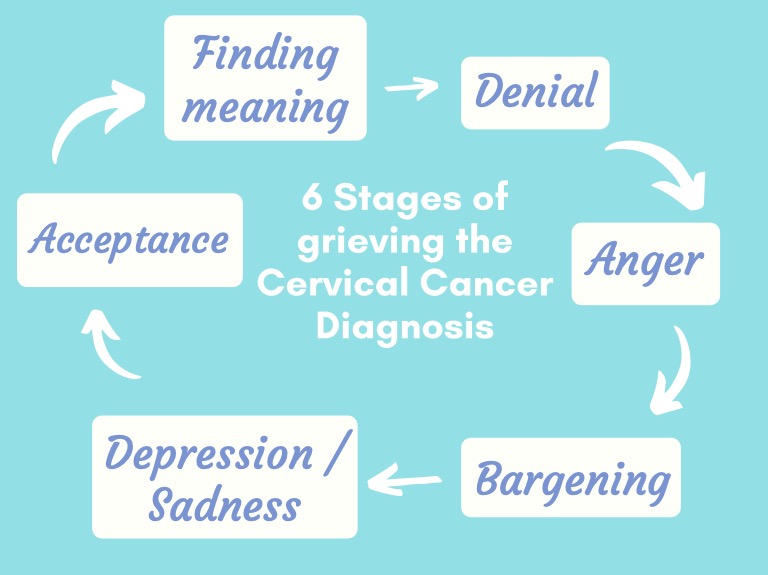
The classical, six stages of grief are simply tools to help us frame and identify what we may feel during our cervical cancer journey:

Denial: Feelings of avoidance, shock, fear, confusion. Believe that the diagnosis is somehow wrong and holding on to a different reality.

“I feel fine.” – “No, this can’t be happening to me.”

Anger: Feelings of frustration, anger, anxiety. Faced with the new reality, looking for someone/something else to fault, to leash out.

“Why me?” – “It’s not fair.” – “How can this happen to me.”

Bargaining: Struggling to find meaning. Seeking to get out of facing the new reality by promising something to change or to do differently or seeking for help through a higher power.

“I’ll do/give anything for a good outcome/a few more years.”

Depression / Sadness: Feelings of being overwhelmed, helpless, hopeless. Settling into sadness and unable to move forward.

“Live will never be the same…” – “What’s the point of going on?”

Acceptance: Feeling of exploring different options, a new plan in place, moving on. Embracing the new reality and finality of what has happened.

“I’m going to be ok.” – “I can fight it.” – “I may as well prepare for it.”

The more we give grief space to run its course, the more likely we are to have a better outcome. Sometimes we feel guilty for taking too long to grieve. NO, WE DON’T TAKE TOO LONG! Emotions work their way through us, don’t fight them, don’t rush them.

Years ago, I went to a lecture about grief and the professor added “Finding meaning/Purpose” as the last stage of grief in the circle and that stuck with me. Now, I always add that stage for my clients because I have experienced it myself.

Finding meaning/Purpose:

  • Help other people with the same diagnosis by sharing your story
  • Write a book
  • Pull back from work/toxic people
  • Join an organization
  • Smell/water flowers
  • Take a walk every day
  • See the beauty of life

For me personally, finding meaning/purpose just started in November 2021 (yup, not too long ago), when I decided to participate in one of Cervivor’s Creating Connections virtual meetups. I’ve always been pretty private about my cancer diagnosis. I was terrified about this cancer, I just wanted it to go away, I did not want to share anything with anyone other than my closest family. 

At this first meetup, I literally just listened to the other participants and there was so much hope, so much encouragement, and so many awesome ideas being shared for the upcoming Cervical Cancer Awareness Month (CCAM) in January, that I decided to participate in a second meetup. There, I started to introduce myself, shared a little bit of my story, and thought about ways to integrate some mental health ideas into CCAM.

Since then, I participated in Cervivor’s CCAM virtual activities and even spoke about self-care and mental health at the Cervivor Summit 2022. And today, here I am, continuing to find my meaning/ purpose. 

“Cancer cannot cripple love, it cannot shatter hope, it cannot conquer the spirt.” ~Author Unknown

Jessica Martin was born in Germany and holds a M.Sc. in Psychology. She moved to the USA in 2018 and was diagnosed with cervical adenocarcinoma 1B2 shortly after her move. Jessica is passionate about the mental health aspect for healing.